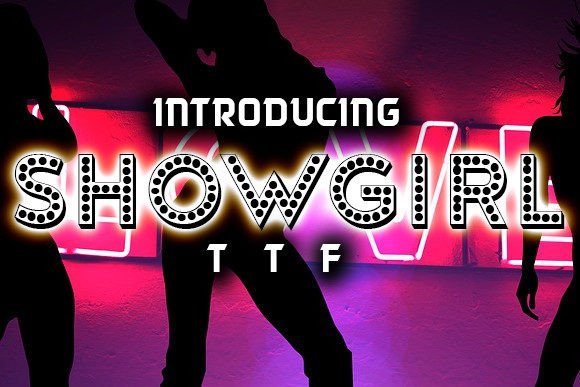
Showgirl Display Font for Handmade Creators
As someone who designs printable wall art, prints labels for small-batch candles, and cuts vinyl for boutique tote bags, I know how much a single font can shape the look—and success—of a physical product. That’s why Showgirl has become one of my go-to display fonts. It’s not just eye-catching—it’s purpose-built for makers who need bold visual impact *and* real-world usability.
Showgirl is a vibrant 3D display font with playful depth, subtle beveling, and confident curves. It’s not overly ornate, but it’s never flat—there’s warmth in its letterforms, energy in its spacing, and clarity even at smaller sizes. Think of it as the kind of typeface that makes your “Hand-Poured Soy Wax” candle label feel luxe, or turns a simple “Happy Birthday” card into something guests actually pause to admire.
I use Showgirl most often where first impressions matter: product tags, market booth signage, wedding welcome boards, and digital printables sold as instant downloads. Its strong silhouette holds up beautifully when cut on Cricut or Silhouette machines—even at 1.25 inches tall on fabric tags. On matte sticker paper, the 3D effect reads as rich texture rather than glare, and on kraft paper packaging, it adds just enough contrast without shouting.
For greeting cards and invitations, Showgirl shines in titles and names. I’ve used it for bride-and-groom monograms on foil-pressed wedding suites, and for “You’re Invited!” headers on rustic-chic baby shower invites. It’s not ideal for full paragraphs (it’s a display font, after all), but it excels where you want emphasis: event names, shop slogans, seasonal banners (“Pumpkin Spice & Everything Nice”), or boutique logo lockups paired with a clean sans serif for body text.
Readability is where Showgirl surprises many crafters. Because its letterforms are open and well-proportioned—not overly condensed or stylized—it stays legible even when scaled down to 18pt on 2x3 inch product labels. I tested it on 3/4-inch round stickers for bath bomb jars: no letter collisions, no confusing glyphs (the lowercase “a” and “g” are distinct, the “R” doesn’t blur into the “B”), and the 3D layer remains subtle enough to avoid registration issues during print or cut.
Pairing Showgirl thoughtfully makes all the difference. For farmhouse-style signs or coffee shop merchandise, I pair it with a relaxed serif like Playfair Display—elegant but grounded. For modern stationery or SVG bundles aimed at millennial moms, I combine Showgirl with a friendly, rounded sans like Quicksand or Nunito. And if you’re designing a script-heavy collection (think hand-lettered quotes or cursive quotes), Showgirl works brilliantly as the bold anchor—its weight balances delicate flourishes without competing.
When prepping files for commercial use, I always double-check what’s included. Showgirl comes in OTF and TTF formats—both work reliably in Canva, Silhouette Studio, Cricut Design Space, and Adobe Illustrator. There are no extra swashes or alternate characters listed, which keeps things simple for production-focused sellers. That said, its consistent baseline and generous x-height mean it aligns cleanly with other fonts in layered mockups, and it supports standard Latin characters—perfect for English-language product labels, Etsy listings, and printable planners sold to US and Canadian customers.
Here’s where practicality meets peace of mind: Showgirl is licensed for commercial use. That means you can use it on physical products you sell—t-shirts, mugs, enamel pins, wooden signs—as well as in digital templates, SVG cut files, Canva-compatible planners, and printable party kits. You can embed it in client deliverables (like custom invitation suites) and include it in design assets you license to other creators—no hidden restrictions, no per-download fees. Just clear, small-business-friendly terms.
I’ve used Showgirl across seasons with great results. Last spring, it anchored a set of “Fresh Cut Flowers” labels for local florists—printed on recycled kraft tags, then tied with twine. Over the holidays, it powered festive mug designs (“Cozy & Cinnamon”) and acrylic ornament templates sold as instant downloads. And for summer markets, I cut it from holographic vinyl for “Sunshine & Sea Salt” tote bags—every letter popped under outdoor lighting, yet still felt handmade, not mass-produced.
What sets Showgirl apart isn’t just its 3D flair—it’s how consistently it translates from screen to physical object. Whether you’re printing on textured cardstock, cutting heat-transfer vinyl, or exporting PNGs for social media promos, it retains its character without distortion. That reliability saves time on revisions, reduces customer questions about font rendering, and helps build brand consistency across your product line—even if you’re juggling five different offerings.
If you’re building a cohesive shop identity—say, a botanical-themed printable line or a minimalist jewelry brand—Showgirl gives you a distinctive typographic signature that’s memorable but not limiting. It’s bold enough to stand alone on a 24x36 poster, refined enough for a delicate thank-you card footer, and versatile enough to scale across stickers, web graphics, and packaging without feeling repetitive.
One final note: because it’s a display font, don’t force it into roles it wasn’t designed for. Skip using Showgirl for ingredient lists on soap labels or multi-line shipping addresses. But lean into where it thrives—titles, names, slogans, decorative accents, and any word that deserves to be seen, remembered, and loved.
For crafters who value both aesthetic joy and production ease, Showgirl delivers. It’s the kind of font that makes your work look intentional, polished, and unmistakably *yours*—without slowing you down.